I’ve previously published in First Monday on mail digitization through Smart Communications, particularly in the instance of the Pennsylvania Department of Corrections (DOC). That research shows that moves toward ICTs in carceral facilities introduce new forms of information control and are typically utilized for surveillance that affects people inside of jails, prisons, detention centers, and other facilities as well as their families, friends, and other contacts on the outside. This means that new ICTs in prisons not only increase coordinated surveillance of people already most likely to experience the brunt end of racism in policing, but also that the algorithms utilized in these new forms of surveillance are refined through compulsory applications in carceral facilities. Due to bias in policing and incarceration, these “data pools” include more Black, Indigenous, and people of color than there are in the general population of the United States. By refining surveillance technologies in jails, prisons, and detention centers, companies create increased opportunity for racism in policing and incarceration, often while working under the guise of neutrality.
Smart Communications is not shy about its’ intended purpose of surveilling the communications between people, even as prisons have justified the introduction of these technologies as necessary in order to regulate contraband. In one of the earliest instantiations of what is now known as MailGuard (registered trademark), an employee of the then 20-person company “explained that all mail is stored for each inmate and is searchable by agency staff at any time, even years after the inmate is released.” Data mining is listed as one of the company’s five core services on its current website.
At the time my article was published, the only state-level facility to have adopted Smart Communications mail digitization was the Pennsylvania DOC. In the two years since, Michigan DOC has adopted a similar process for digitizing mail, more jails have contracted Smart Communications digitization (here are three examples), Smart Communications has issued at least one lawsuit against carceral facility staff around their mail digitization patents, and the Massachusetts DOC and the Federal Bureau of Prisons both piloted Smart Communications mail digitization technology.
The Federal Bureau of Prisons (BOP) interest in Smart Comunications technology is particularly of note. At the time of my research, the Federal BOP had maintained the same mail policy for at least 20 years. It is not a system prone to change. Policies created in that system are likely to not only bolster the income and perceived prestige of Smart Communications, but also will increase the likelihood that mail digitization technologies are implemented in carceral facilities across the country. As a system that serves as a model for carceral practices, a change to mail policies in federal prisons will have lasting consequences on how smaller-scale and more local systems are able to surveil people who are incarcerated and their connections in the general public. While Smart Communications claims that mail legal mail is not digitized, there is existing precedent for monitoring digital attorney-client communications. The Federal BOP already potentially monitors all electronic communications, legal and personal, made through TRULINCS, though there is political effort underway to create a new software that does not monitor legal communication. (An aside: the Federal BOP is also a system that does not trust its own employees to have consistent internet access at work.)
Physical mail in prisons is already highly regulated. For example, in California, some prison issued envelopes contain a list of materials that will be rejected —
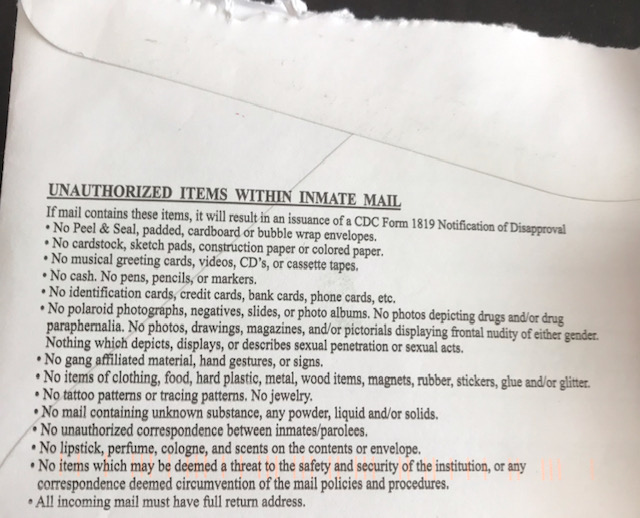
Even as facilities across the United States implement similar restrictions as those printed on this envelope, the physical mail has allowed for people to maintain meaningful relationships and access information. Aside from issues with mail loss, delays, and scanning failures (also here), digitizing and surveilling by-mail communications will effect how people express themselves and maintain their shared humanity through the physical mail.
Libraries across the country receive information requests from people who are incarcerated, and formal Reference by Mail services are proliferating. These services are necessary because information is increasingly born-digital and available only online, and people who are incarcerated have (aside from a few sparse examples) no sanctioned access to the Internet. From a librarian perspective, it is important to note that a watchful eye has a cooling effect on all types of information requests, be they related to pop culture, a passing moment of curiosity, reentry planning, personal and collective identity, or academic pursuits. It is within our professional concerns to resist efforts to digitize and surveil the mail to and from people who are incarcerated.

 Jeanie Austin, PhD