Content Restrictions and Media Review in Prisons

ITHAKA S+R has released a report that brings together and analyses the content restrictions and media review practices of prison systems in the United States. The post announcing the report highlights that:

  • Key terms and language are common across DOC censorship policies. Despite strong similarities in language and framing, however, the policies and procedures related to common terms differ greatly across states.
  • Forty-two of 51 media review directives limit the vendors from which materials can be purchased. This type of “content-neutral” restriction limits the availability of information and may increase costs and logistical burdens on higher education in prison programs, students, and autodidactic learners.
  • Forty-four of 51 media review directives have clauses addressing and limiting access to sexually explicit or obscene content. The reasons for this are historically complicated, but these policies are currently intended to maintain an environment free of sexual harassment. In some cases, however, these policies explicitly target LGBTQ+ content. Such policies can affect access to educational materials from art history and biology to contemporary queer literature.
  • The legal power of DOC to surveil and censor is grounded in the protection of “security, good order, or discipline.” In practice, the term frequently serves as a catchall, providing broad latitude to censor media. This covers a startling amount of ground, justifying everything from banning books on community organizing or union history, to prohibiting access to fantasy novels that have maps of fictional lands.
  • Content protection clauses or carve outs exist and primarily allow access to educational or culturally significant content. While such provisions ostensibly allow access to publications that might otherwise be censored, the way these policies are framed often narrowly limits application.
  • Publication review and censorship appeals processes are addressed to some extent in nearly all policies. However, appeals processes often inequitably burden people who are incarcerated and the programs that seek to serve them.

The full report includes a media review policy that can be used to craft a more transparent and less arbitrary review process for materials.

Interested in learning more about banned books inside of prisons? The Marshall Project has recently released a new tool for viewing banned books lists by state.

I am guest editor on a forthcoming issue of the Journal of Intellectual Freedom & Privacy on the topic of carceral systems and censorship. Look out for the issue later this year!

History of Services

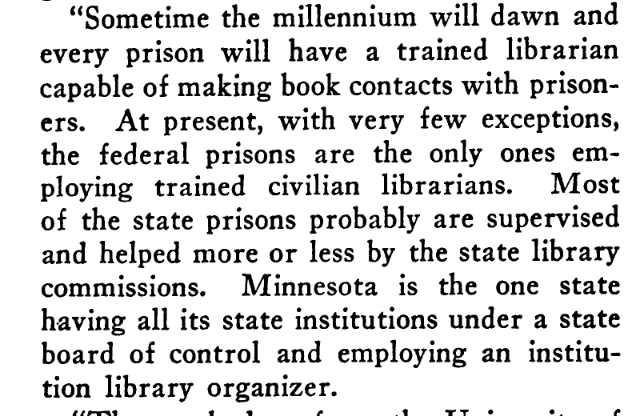
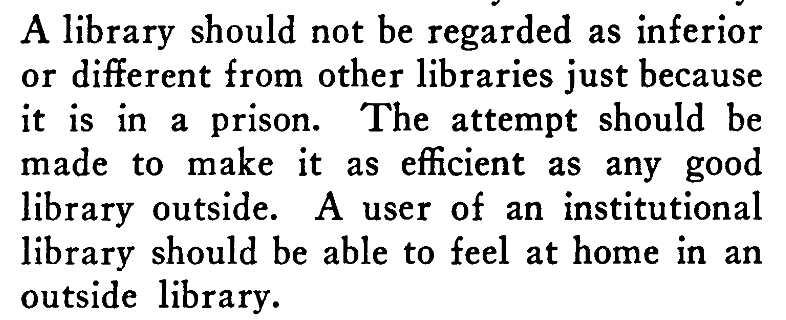
The 1982 Library Services in Federal Prisons survey is a treasure trove! (This survey was conducted by the Federal Prisons Committee of the Library Services to Prisoners Section of the American Library Association.) In addition to an analysis of contemporaneous library services in federal prisons, it includes a comprehensive history of library services in federal prisons. That history led me to these 1933 passages–

Excerpted from Jones, E. K. (1933). Institution Libraries Round Table. Bulletin of the American Library Association, 27(13), 706–715.

These types of discoveries help me to position my own work within the larger, often difficult to locate, scope of library services for people who are incarcerated. They also attest to the great need for more services. The new millennium imagined in 1933 has not yet arrived.

Despite this, there is a renewed energy within the profession and among LIS students for attention to library services for people who have been incarcerated. Change may still be on the horizon.

Many thanks to the American Library Association Archives for making this research possible.

Timeline Additions

I’ve spent most of this week in the American Library Association Archives, sifting through information about library services and incarceration. I started around 1950 and am moving my way forward to the present (sorry for the deep history buffs! Maybe I’ll return; or maybe that is a project for someone else!).

I’ve found some events that aren’t recorded in the timeline that will be published with my book. Here is a preliminary summary of a few, for the record:

  • A 1976 ALA Resolution on Service to Detention Facilities and Jails, which likely led to the formation of the National Institute on Improving Jail Library Services. The Resolution is available here.
  • A survey of library services to local institutions that took place through the late 1970s and was published by ALA in 1980.
  • A 1980 replication of a 1938 survey of library services in the federal Bureau of Prisons. Among other highlights, the survey report, which was made available in 1982, was condemned by the BOP for the “negative, belligerent” tone of recommendations.

As I continue to review the materials I’ve digitized on this trip, I’m hoping to find more information about the tensions between the American Correctional Association (ACA) and the American Library Association (ALA) regarding the inclusion of a Prisoners’ Right to Read statement in the 1980s version of the Library Standards for Adult Correctional Institutions. So far I’ve only located passing references to a “current controversy over accreditation standards of libraries in prisons.”

As a reminder, much of my interest in surveys aligns with the open survey on Library Services and Incarceration.

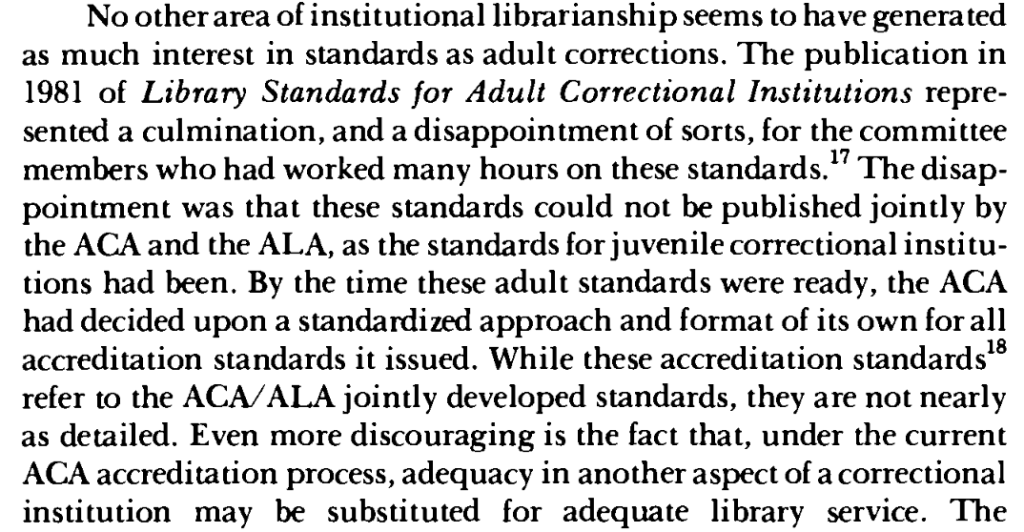
Update 1/9/22: Richard Miller’s 1982 article on institutional library standards briefly discusses the coordinated work of ACA and ALA on the 1975 Library Standards for Juvenile Correctional Institutions as “nothing short of a major coup, because a nonlibrary organization joined with ALA to issue library standards.” There is mention of the effort for a joint revision of the adult standards as, “bogged down when ACA decided to make changes in its accreditation process.” Miller expand on this–

Miller, R. T. (1982). Standards for library services to people in institutions. Library Trends, 31, 109–124.

New Article and Survey Launch

Chelsea Jordan-Makely and I have been collaborating to locate information about academic, public, and special library services for people who are incarcerated or in reentry. Today, our article summarizing these services–Outside and In: Services for People Impacted by Incarceration–went live through the Library Journal website. It will also be available in print later this month.

We doubt that we’ve located everything, and can’t wait to find out about other libraries providing books, programs, or other library services for people who are incarcerated or in reentry. That’s why we’ve teamed up with the Library Research Service at Colorado State Library to create a survey about this type of service!

Academic, special, and public librarians and staff are encouraged to respond.

You can access the survey at Library Services and Incarceration.

Public Library Services to Incarcerated People

While many public libraries in the United States likely offer some type of service to people in jails, prisons, detention centers, or in the process of reentry, it is surprisingly difficult to locate information about these programs. A new project is seeking information on public library initiatives that are intentionally providing services to people impacted by incarceration.

To view what they have already gathered, please click here.

To add information to the document, please contact me.

For more context on the information gathering project, please visit Renewed Libraries.

I believe that a detailed list of public libraries providing these programs will allow librarians to find one another, consider innovative ideas, and present supporting evidence that it is the role of the public library to provide information and services to people impacted by incarceration. I’m very excited to see this list grow!